
For decades, the global automotive market was dominated by European, American, Japanese and Korean brands. Driven by worldwide electrification, traditional automotive giants have moved slowly in transition. The global automotive landscape is undergoing historic restructuring. This transformation breaks old market barriers and creates a rare window of opportunity for Chinese automakers to go global. Sichuan Jiayihao International Trade Co.,Ltd specializes in complete vehicle export. Based on global auto trade trends, we analyze multiple benefits brought by the new market pattern to Chinese automakers.

- Global electrification transition creates market gaps as legacy automakers lag behind
Carbon neutrality and new-energy transformation have become global consensus. Many countries have released timetables for phasing out fuel vehicles and promoted electric vehicle adoption. Established European, American, Japanese and Korean automakers have long focused on internal combustion engine technology. They started late in electrification investment and battery supply chain layout, with relatively slow product iteration. They cannot quickly satisfy surging global demand for EVs.
Obvious supply gaps appear in the market. Overseas consumers and dealers are in urgent need of cost-effective, intelligent new energy models. With a complete three-electric industrial chain, Chinese automakers can rapidly launch mature BEV and hybrid vehicles to fill global market shortages. Sichuan Jiayihao International Trade Co.,Ltd supplies a wide range of domestic new-energy passenger and commercial vehicles for global clients, helping overseas dealers seize local electrification dividends.
- Diversified market demand releases massive growth in emerging markets
The global auto market growth is no longer limited to mature markets in Europe and America. Emerging regions including Southeast Asia, the Middle East, Central Asia, Africa and Latin America become major growth drivers. Local economies keep developing, and residents’ demand for cars rises rapidly. However, the local automotive industries are weak with limited production capacity and few vehicle options.
Regional demands vary greatly: the Middle East prefers large-space SUVs; Southeast Asia has strong demand for compact family cars and hybrids; Africa prioritizes durable, easy-to-repair fuel vehicles; Latin America demands both fuel cars and affordable EVs. Chinese automakers own a comprehensive product portfolio. They can customize vehicles for different regions, support right-hand drive conversion and heat & dust adaptation to meet local driving requirements. Diverse emerging markets serve as the primary growth engine for Chinese auto exports.
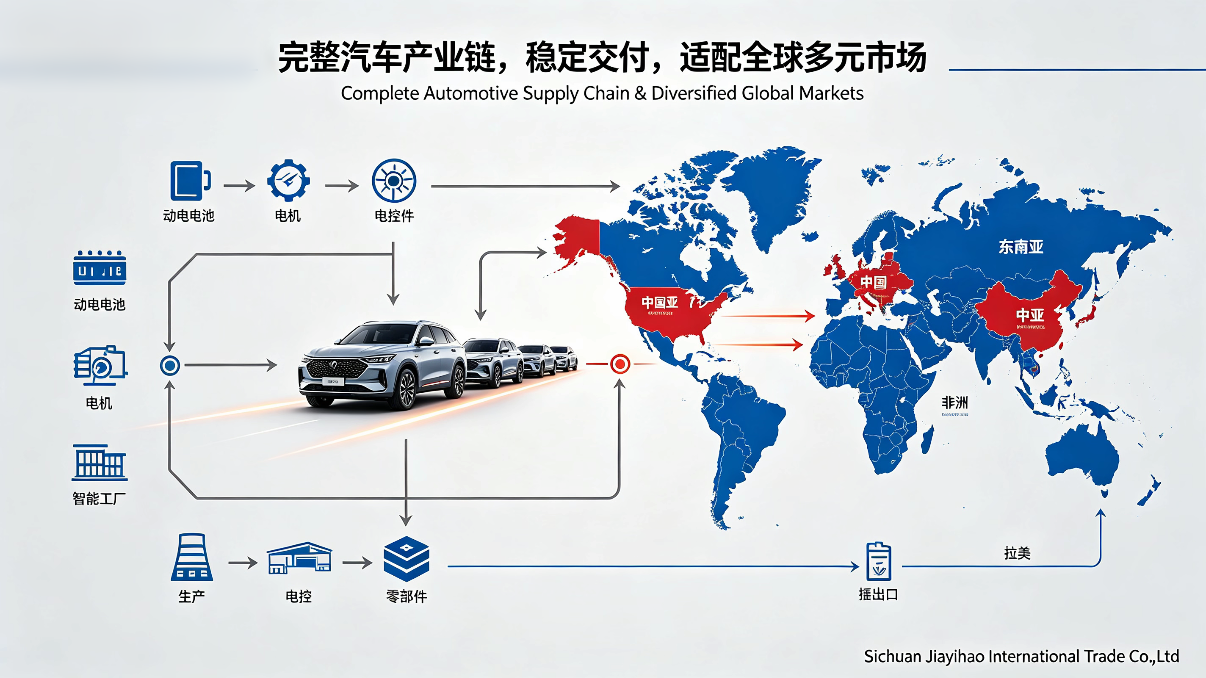
- Global supply chain reshaping highlights China’s full industrial chain advantages
The global automotive supply chain has experienced repeated disruptions. Many overseas automakers suffer parts shortages and extended delivery lead times. China owns the world’s most complete automotive industrial chain, covering power batteries, motors, electronic control systems and body components. Mature industrial clusters and mass production ensure stable output and shorten order cycles.
Under unstable global supply chain conditions, stable production capacity and reliable delivery become core strengths of Chinese automakers. Overseas buyers increasingly prioritize suppliers who can deliver vehicles on schedule, which is a standout advantage of Chinese auto exports. Leveraging mature domestic industrial resources, Sichuan Jiayihao International Trade Co.,Ltd provides one-stop vehicle export services covering production coordination, documentation and international logistics for global customers.
- Shrinking market share of legacy automakers creates room for new brands
In recent years, traditional European, American, Japanese and Korean automakers have lost global market share continuously. Their products are usually priced higher with slow updates on intelligent features, failing to meet emerging markets’ demand for well-equipped and cost-effective vehicles.
By contrast, Chinese vehicles are equipped with smart cockpits, ADAS and fast charging within the same budget level, showing outstanding competitiveness. Overseas dealers introducing Chinese automobiles can enrich their product lines and achieve better profit margins. This motivates numerous international dealers to actively source complete vehicles from China, opening overseas sales channels for Chinese cars.
- Diversified global trade reduces risks from over-reliance on single markets
In the past, global automobile trade concentrated heavily in a small number of developed nations with weak risk resistance. Today, global trade patterns become diversified. Many countries actively expand import sources for automobiles instead of relying solely on traditional auto manufacturing powers.
This trend benefits Chinese automakers. They can carry out multi-region layout, develop multiple overseas markets simultaneously and mitigate risks caused by tariff adjustments and policy changes. Whether fuel vehicles or new energy cars, Chinese automakers can expand in both mature and emerging markets to continuously increase global coverage.
Challenges coexist with opportunities
Although the global market transformation brings dividends for Chinese automakers going global, exporters still face challenges such as national import certifications, local regulations, trade barriers and overseas after-sales network construction. When purchasing vehicles, overseas dealers need professional and reliable complete-vehicle export service providers to avoid risks in compliance, logistics and paperwork.
Sichuan Jiayihao International Trade Co.,Ltd focuses on Chinese complete vehicle export. We provide one-stop services for global auto dealers including fuel and new-energy vehicle sourcing, regulatory consultation, full foreign-trade documents and international ro-ro shipping, helping overseas partners capture business opportunities brought by the transformation of the global automotive industry.